

Praetorian Fiber Optic Sensing System
Please visit our dedicated site www.hawkfiber.com for comprehensive information about HAWK's Fiber Optic Sensing solutions.
Fiber Optic Sensing is a relatively new facet of industrial instrumentation that allows for real-time measurements of long assets such as pipelines, conveyors, and perimeters. HAWK’s Praetorian Fiber Optic Sensing System is the only system on the market that offers a single interrogator that measures Distributed Acoustic Sensing (DAS), Distributed Temperature Sensing (DTS), and Distributed Strain Sensing (DSS) all in a single enclosure.
The advantage of making these measurements in a single system means that parallel measurements of strain, temperature, and acoustics may be made in their most basic form by a single processor in real-time allowing for better pattern recognition, resulting in faster acquisition and confirmation of events. Another advantage of HAWK's Praetorian Fiber Optic Sensing System is that it ignores false alarms, resulting in one of the most accurate and trustworthy systems on the market.
This revolutionary technology can protect assets, equipment, and perimeters. HAWK’s Fiber Optic System is modular in design and can monitor up to 50km (31.1 mi) in real-time 24/7. This type of intelligent monitoring is critical to operating efficiently and protecting valuable assets.
Principle of Operation
The Fiber Optic Sensing System uses a combination of Rayleigh backscatter and time of flight technology to determine the presence, location, intensity, and frequency of vibrations along with an optical fiber in real-time. The Fiber Optic Sensing System can be operated directly or connected to an existing Control System such as a SCADA. The Fiber Optic System can provide alarm notifications (red, amber, and green) depending on the condition of the components. Reporting and alarms can be sent to smartphones, tablets, and computers via SMS and email alerts. The report includes the location of an alarm, the alarm classification, its longitude and latitude, the alarm intensity as well as the time and date.

Features of HAWK's Fiber Optic Sensing
The Praetorian system is engineered for reliability in the world’s most demanding industrial environments:
- Proven ROI — pays for itself with the detection of a single event.
- Immune to cut fiber — the system continues to operate and report the cut location even if the cable is severed.
- Intelligent false alarm rejection — advanced signal processing ignores ambient noise so alerts are accurate and actionable.
- Passive technology — no electrical power required in the field, dramatically reducing installation cost and hazard risk.
- Self-diagnostics — the system continuously monitors its own health and alerts operators to any degradation.
- Zero routine maintenance — solid-state design with no moving parts or consumables.
- 80km (50 miles) range in a single processor — covering entire pipeline corridors or conveyor runs from a single installation point.
- 24/7 continuous monitoring — real-time alerts with simultaneous strain, temperature, and acoustic measurement.
Fiber Optic Sensing Applications
The Praetorian system is deployed across the world’s most critical infrastructure. Current applications include:
- Conveyor Monitoring — detect belt fires, rip events, splice failures, and abnormal vibration before they cause costly shutdowns.
- Pipeline Monitoring & Leak Detection — detect third-party intrusions, ground movement, and leak events across long pipeline corridors.
- Perimeter & Fence Security — precisely locate intrusion events along extended perimeters with minimal false alarms.
- Roads, Railways & Tunnels — monitor rail structural health, thermal stress, and unauthorized trackside access in real time.
- Bridges & Power Cables — monitor thermal load, partial discharge, and fault events along underground and above-ground power infrastructure.
- Tailings Dam Monitoring — detect geological stress, seepage, and ground movement to prevent catastrophic dam failures.
How the Praetorian Fiber Optic Sensing System Works
The Praetorian system is based on Rayleigh backscatter — a naturally occurring optical phenomenon in which a small fraction of the light pulsed into the fiber reflects back to the interrogator unit. By measuring the time-of-flight of these reflections, the system can pinpoint the precise location of any acoustic or thermal event along the cable’s length.
This distributed acoustic sensing (DAS) approach transforms the entire fiber optic cable into a dense array of virtual microphones and temperature sensors, providing location-accurate detection with no blind spots and no additional sensing hardware.
HAWK Fiber Optic Sensing FAQs
What makes HAWK's fiber optic sensing system different from traditional point sensors?
Traditional sensors monitor discrete locations and leave gaps in coverage. HAWK's Praetorian Fiber Optic Sensing System uses the fiber optic cable itself as a continuous sensing element, giving you uninterrupted detection along the entire length of your asset — up to 80km (50 miles) — from a single processor. No blind spots, no additional hardware in the field.
Does the system require power in the field?
No. The Praetorian is a fully passive technology — no electrical power is needed along the fiber cable itself. This dramatically reduces installation cost, eliminates hazard risk in classified environments, and makes it viable for extremely remote deployments like pipeline corridors or mining sites.
Can one system monitor multiple asset types simultaneously?
Yes. The Praetorian measures strain, temperature, and acoustic signals simultaneously on a single fiber — meaning one processor can serve multiple monitoring functions across a single run of cable. HAWK also offers application-specific models (FOS, FOS-1, FOS-2, FOS-3, FOS-4) optimized for conveyors, pipelines, perimeters, power cables, and tailings dams respectively.
What is distributed acoustic sensing (DAS) and why does it matter?
DAS is the technology underpinning the Praetorian system. It works by pulsing light into a fiber cable and measuring the Rayleigh backscatter — tiny reflections that occur naturally as light travels through the glass. By analyzing the time-of-flight of these reflections, the system pinpoints the exact location of any acoustic or thermal event. The result is a dense array of virtual sensors with no additional hardware.
Fiber Optic Sensing Systems
HAWK offers a range of Praetorian units optimized for specific applications. Each model shares the same core distributed fiber optic sensing platform, ensuring consistent performance and ease of integration:
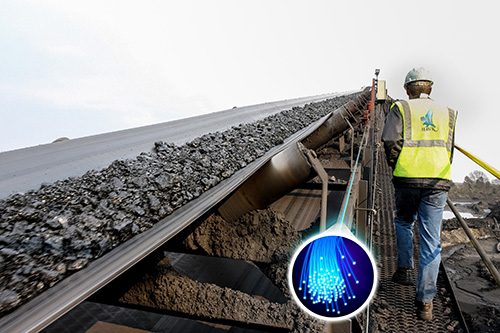
Praetorian Fiber Optic Sensing Conveyor Health Monitoring System
The Praetorian Conveyor Health Monitoring System (CHMS) is a plant & site-wide single solution for detecting when critical parts of the idler are beginning to fail. The early detection warnings allow operators to control downtime and avoid catastrophic costly unplanned shutdowns. HAWK's Praetorian Fiber Optic Sensing detects abnormalities in conveyor idler performance that other technologies cannot.

Praetorian Fiber Optic Sensing for Perimeter Security and Threat Detection
The Praetorian Fiber Optic Sensing System can be installed along a fence or perimeter and can detect, identify and report any movements. This system has limitless applications and can be installed on anything from explosive storage areas to farms and ranches. The fast processing speed and pulse rate allow the Fiber Optic System to detect minute interferences that may otherwise go unnoticed. Some examples of detectable activates include intruder movement along a perimeter, intruders cutting or climbing a fence, vehicle movement along a perimeter and digging, excavating or trenching. The Fiber Optic Sensing system is crucial for keeping valuable assets secure and protected.

Praetorian Fiber Optic Sensing for Pipeline Monitoring and Leak Detection
The Praetorian Fiber Optic Sensing System can be installed on a buried or unburied pipeline and can immediately detect pipeline leakage, ground disturbances, manual and machine excavation, theft, hot tapping and vehicle movement. The Fiber Optic System continually monitors large spans of pipeline, looking for vibration and temperature changes. Once a detection occurs, the system alerts the operator or security personal to the exact location of disturbance in the pipeline. This type of real-time intelligent monitoring is critical to operating efficiently and protecting valuable assets.

Praetorian Fiber Optic Sensing for Power Cable Monitoring
The Praetorian Fiber Optic Sensing System can monitor buried and unburied data cables, wires and power transmission lines. Monitoring for wear, damage or corrosion of the cable is extremely difficult and often power failure or data outage is the first sign of a problem. These cables are typically installed in areas that have multiple uses by various stake holders and in the event of a failure can be logistically difficult and expensive to access for repair. The Praetorian Fiber Optic Sensing System can be installed either near the power cables or embedded within the power cable itself. It can monitor disturbances, identify manual and machine excavation, vehicle movement, ground condition assessment and detects hotspots. HAWK’s Fiber Optic Sensing System requires no additional field infrastructure such as power or communication and does not require maintenance or calibration after commissioning.

Praetorian Geological Stress Detection System for Tailings Dams Monitoring
Tailings Dams are massive structures used all over for the bulk storage of mineral processing wastes. These earthen structures can measure tens of kilometers in length and width and be hundreds of meters tall. In terms of total volume tailings dams are the largest manmade structures in existence. However, over the last 20 years the rate of tailings dams failing has doubled. Failures of tailings dams are perhaps the worst possible case scenario for any mineral extraction operation. Events causing loss of life in the hundreds or even thousands, Environmental fines reaching billions of dollars and the loss of facility infrastructure and production are a confronting prospect. HAWK has developed a solution to prevent tailings dams failure. HAWK's Praetorian Geological Stress Detection System utilizes fiber optic sensing technology for the real time monitoring of field strain within earthen structures. This revolutionary technology uses fiber optic cables that are then inserted into the structure through drilled boreholes. These cables monitor field strain and deflection caused by dam loading and report both the borehole position and depth where the strain or deflection is occurring within the retaining wall structure. Sensitivities achievable with the Praetorian Geological Stress Detection System means that potential issues with ground shift can be detected and intercepted well in advance of visually symptoms of structural issues.